
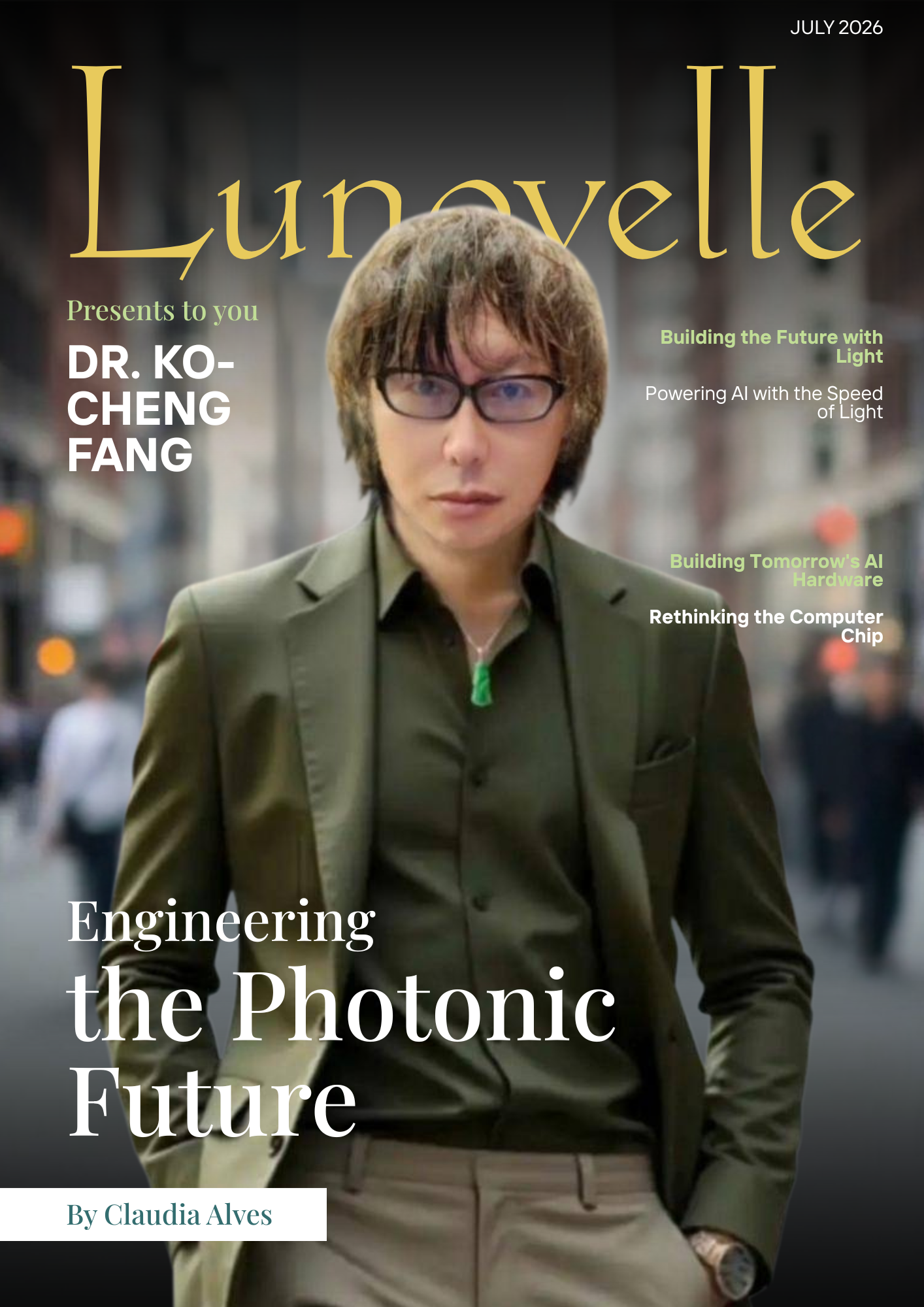
For generations, technological progress has been measured by one thing: the ability to process information faster.
From room-sized computers to smartphones that fit in the palm of a hand, every major leap in technology has been driven by advances in computing power. The rise of the internet, cloud platforms, artificial intelligence, and intelligent automation all became possible because semiconductor chips continued to become faster, smaller, and more powerful.
Today, however, the technology industry finds itself standing at a crossroads.
Artificial intelligence is evolving at a pace that few predicted. Large-scale AI models require enormous computational resources, advanced memory systems, and unprecedented levels of energy consumption. Around the world, technology companies are investing billions of dollars into infrastructure capable of supporting the next generation of intelligent systems.
Yet despite these investments, one question remains unanswered:

Can traditional electronic chips continue supporting the future demands of artificial intelligence?
According to Dr. Ko-Cheng Fang, Founder, CEO, and Chairman of LongServing Technology, the answer may require a fundamental shift in how computing itself is designed.
On April 23, 2026, LongServing Technology officially introduced the architectural framework of its photonic quantum chip technology. The announcement revealed three major designs: a three-dimensional photonic chip model, a complete photonic pathway architecture, and a photonic full-adder structure.
Together, these designs represent the company’s vision for a future in which light replaces electricity as the primary medium of computation.
At first glance, the idea appears straightforward.
Instead of relying on electrons flowing through microscopic circuits, photonic chips use photons—particles of light—to carry information. Because photons travel faster and generate less heat than electrical current, photonic systems have long been considered one of the most promising alternatives to conventional semiconductor technology.
However, transforming that concept into a practical computing platform has remained one of the greatest challenges in modern engineering.
For years, photonic computing existed largely as a theoretical goal. Researchers understood its potential benefits, but scaling optical systems into compact, high-performance architectures proved extremely difficult.
LongServing Technology’s newly disclosed designs attempt to bridge that gap.
One of the most innovative aspects of the architecture is its three-layer structure.
The foundation layer serves as photonic memory, allowing optical information to be stored directly within the chip. Above it sits the photonic logic layer, where computational functions are performed. The top layer contains photonic pathways responsible for directing optical signals throughout the system.
This configuration differs significantly from traditional semiconductor chips, which often require numerous structural layers to accommodate increasingly complex electrical circuits.
According to LongServing Technology, photonic systems can achieve high functionality through a simpler and more efficient architecture.
The company has also introduced a distinctive 45-degree optical routing design.
Conventional electronic chips were engineered around the movement of electrical current. Photons behave differently. As a result, Dr. Fang’s architecture was designed specifically around optical transmission rather than adapting traditional electronic layouts.
This approach allows the chip to optimize the movement of light through the system while demonstrating the stacking potential necessary for future expansion.
Equally important is the integration of photonic memory into the architecture.
In today’s computing environments, information frequently moves between optical and electrical formats. Data may be transmitted through optical networks, converted into electrical signals for processing, and then converted again for communication.
While these processes occur rapidly, they still create inefficiencies.

Photonic memory aims to reduce these conversion losses by allowing information to remain in an optical state throughout much of the computational process.
According to Dr. Fang, this capability could unlock performance improvements that far exceed what is achievable with conventional electronic systems.
At the heart of the project is another major innovation known as X-Photon.
One of the biggest obstacles facing photonic computing has always been wavelength size. Traditional optical technologies often operate at wavelengths far larger than the nanoscale dimensions used in modern semiconductor manufacturing.
To overcome this limitation, Dr. Fang developed X-Photon, a photonic quantum material capable of emitting light at approximately 2 nanometers.
This breakthrough is particularly important because it aligns optical systems more closely with the scale required for advanced chip fabrication.
Smaller wavelengths allow for denser optical pathways, enabling more compact and powerful photonic architectures.
In many ways, X-Photon serves as the technological foundation supporting LongServing Technology’s broader vision for photonic quantum computing.
The implications extend far beyond faster processors.
Artificial intelligence is rapidly becoming one of the largest consumers of computing resources in human history. Training advanced AI systems requires massive amounts of computational power. Operating those systems requires enormous infrastructure investments.
As demand continues growing, so do concerns regarding energy consumption, operational costs, and environmental sustainability.
Photonic computing offers a compelling alternative.
Because photons generate significantly less heat than electrons, optical systems could reduce cooling requirements while improving overall energy efficiency. This combination of performance and sustainability has made photonic computing one of the most closely watched areas of advanced technology research.
Potential applications include artificial intelligence, robotics, telecommunications, scientific simulations, healthcare technologies, autonomous transportation systems, aerospace engineering, and cloud infrastructure.
For LongServing Technology, however, the significance of the project goes beyond technical specifications.
It represents a belief that major technological progress often requires rethinking established assumptions.
Throughout history, transformative innovations emerged when existing technologies approached their limits. New breakthroughs arrived not through incremental improvements alone, but through entirely new ways of thinking.
The shift from horse-drawn transportation to automobiles transformed mobility. The transition from analog systems to digital technologies transformed communication. The internet reshaped how information moves around the world.
Today, as artificial intelligence accelerates demand for computing power, another transformation may be approaching.
Photonic quantum computing stands among the most ambitious candidates to drive that change.

While substantial challenges remain before large-scale adoption becomes possible, LongServing Technology’s announcement provides a glimpse into what the future of computing could look like.
A future where processing power is measured not only by transistor density, but by the speed of light itself.
A future where optical systems help power intelligent machines, advanced robotics, scientific discovery, and next-generation AI.
And a future where the boundaries of traditional semiconductor technology give way to an entirely new era of innovation.
Contact Information
Dr. Ko-Cheng Fang
Founder, CEO & Chairman
LongServing Technology Co., Ltd.
Email: service@longserving.com.tw
Website: https://longserving.com.tw/en/
Instagram: @ko_cheng_fang_david